Preliminary Results
Preliminary Results for October 2026
October 2026
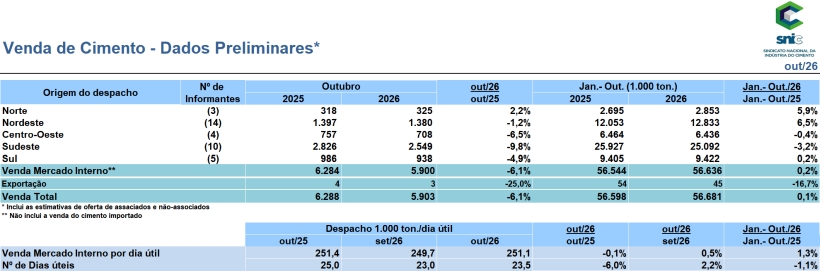
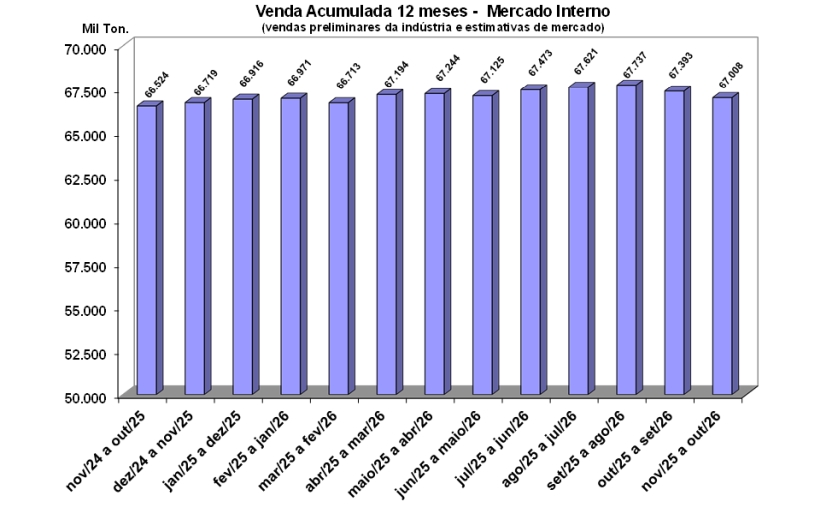
Brazil’s cement industry sold R$5.9 million metric tons in October 2026, down 6.1% from the same month in 2025, according to the National Cement Industry Association (SNIC). From January through October, sales totaled R$56.7 million metric tons, a slight increase of 0.1% over the same period last year.
The sector had already expected this slowdown due to fewer working days. In addition, persistent rainfall hampered construction progress and further worsened the result. The North was the only region that did not record a decline. Nevertheless, a strong labor market and rising sales under the Minha Casa, Minha Vida housing program helped sustain cement demand over the year to date.
The unemployment rate stood at 5.2% in September, the lowest level for that month since the survey began in 2012. The number of employed people reached a new record of 103.6 million. The informality rate and workers’ average earnings remained stable, signaling a possible initial slowdown in the labor market.
Despite high interest rates—with the Monetary Policy Committee (Copom) keeping the Selic rate at 13.75% per year in its latest decision—housing finance continued to expand. The number of housing units financed for construction through the Brazilian Savings and Loan System (SBPE) rose by 96.2% in the year to September compared with the same period in 2025.
However, pressure on household budgets remains a concern. The share of income committed to debt payments reached 50.11% in August 2026, the highest percentage in the historical series and the first time the indicator exceeded 50%. In September, the number of people with overdue debts reached a new record of 84.2 million, with total debts amounting to R$597.4 billion. This situation constrains consumption and may hinder access to housing credit.
The more moderate growth outlook is also affecting expectations among consumers, the construction sector and industry. The consumer confidence index1 rose again, but the recovery was only sufficient to offset the previous month’s decline. High household debt and delinquency levels remain factors that could limit further gains.
In construction2, the indicator also improved, reflecting more favorable business expectations for the coming months. However, the trend was not uniform across segments: while residential construction showed greater pessimism, infrastructure displayed greater optimism, with expectations of growing demand and increased hiring.
Meanwhile, industrial confidence3 declined for the third consecutive month, reflecting slowing demand and inventory accumulation.
On the economic front, inflation expectations increased after the elections. According to the Focus Bulletin, the forecast for the Broad National Consumer Price Index (IPCA) in 2026 rose to 5.22%, while the estimate for 2027 increased from 4.34% to 4.76%. With inflation expected to be higher, the market also scaled back its expectations for interest rate cuts. Adding to this is concern about further cost inflation in industry, driven by higher prices for essential inputs such as diesel, petroleum coke, commodities and ocean freight.
The outcome of the presidential election heightened uncertainty over the direction of economic policy, particularly regarding the government’s fiscal position. Concerns about the public deficit and campaign promises, combined with the appreciation of the US dollar, could put upward pressure on inflation and jeopardize the path toward lower interest rates. At the same time, the sector is closely monitoring, with considerable concern, the repercussions and potential effects of tax reform and the debate over ending the six-days-on, one-day-off work schedule on competitiveness and operating costs in the productive sector. In this context, the need for fiscal adjustment without resorting to a higher tax burden is becoming increasingly important for economic stability and a recovery in investment.
For the cement sector, performance in the coming months will depend on the evolution of housing and infrastructure demand, as well as credit conditions and the economic environment. Continued housing investment, particularly under Minha Casa, Minha Vida, and infrastructure projects, especially those using concrete pavement, remain key factors in sustaining cement demand.