Preliminary Results
Preliminary Results for July 2026
July 2026
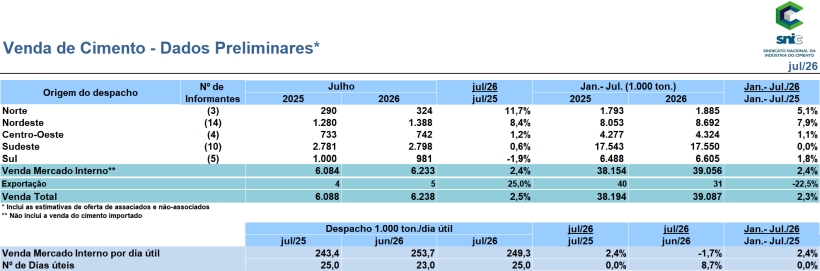
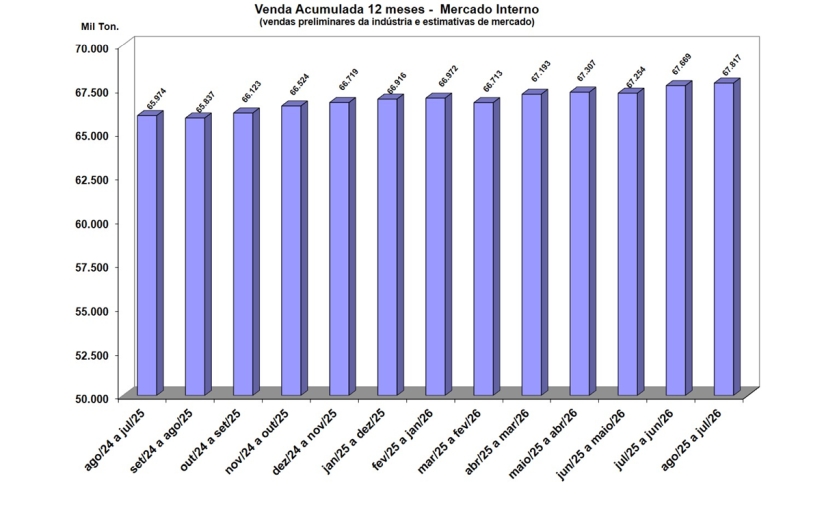
he Brazilian cement industry sold 6.2 million tons in July, a 2.5% increase compared to the same month last year, according to the National Cement Industry Union (SNIC). Year-to-date sales reached 39 million tons, a 2.3% change year-over-year. Shipments per working day totaled 249.3 thousand tons, showing a 2.4% increase over July of last year and a 1.7% decrease compared to June.
Regarding regional performance in July, the North and Northeast regions maintained significant growth, while the other regions showed stable sales—with the exception of Southern Brazil, which was affected by heavy rains.
The sector's results reflect a divided macroeconomic landscape. The unemployment rate fell to 5.4% at the end of June—the lowest level for that month since 2012—accompanied by a record 103.1 million employed people. At the same time, worker income fell for the second consecutive time, signaling a possible cooling of the labor market. Household budgets also remain under pressure: as of May, 49.8% of income accumulated over the previous 12 months was committed to debt, and the number of Brazilians in default reached a record 83.7 million in June, accounting for R$ 579 billion in outstanding debt.
This income commitment was reflected in consumer confidence¹, which declined in July, driven by pessimism among lower-income classes. Conversely, construction confidence² rose, supported by positive assessments from residential building companies—a trend that offset worsening expectations in the infrastructure segment.
Meanwhile, industrial confidence³ recorded its sharpest drop since September of last year, impacted by instability surrounding new US import tariffs and the progression of the election calendar. The market also maintained inflation expectations above the target and revised its Selic rate projection to 13.75% by year-end, following a new 0.25% cut implemented yesterday.
Economic headwinds directly impacted business across the production chain. Sales of construction materials fell by 3.4% in the first half of the year, prompting Abramat to lower its annual growth forecast from 1.9% to 0.5%. The IBGE also reported a 1% drop in construction material sales for the period ending in May.
In the real estate market, sales grew by 4.1% in the first quarter, while new project launches contracted by 4.9%. This trend is directly linked to the *Minha Casa, Minha Vida* (MCMV) program, which accounts for 49% of the country's housing supply. The program saw a 10% surge in sales but a 10% decline in new launches year-over-year. The slowdown in new units reflects how construction companies are adapting to changes in housing policy—specifically, the adjustments to income brackets and property value limits that took effect in late April.
In response to the challenges of the climate transition, the cement industry is advancing its Net Zero Roadmap. To achieve neutrality, the sector is focusing on "tropicalizing" decarbonization strategies and tools, leveraging Brazil's unique climate and biodiversity. Particular emphasis is placed on Nature-Based Solutions (NbS), which offer highly effective alternatives for offsetting emissions in "hard-to-abate" sectors. While disruptive Carbon Capture (CCUS) technologies cost between US$ 150 and US$ 250 per ton of CO2, forest restoration projects in the country range from US$ 15 to US$ 25, combining sustainability with the urgent national need to combat deforestation.
"The resilience of sectoral sales is underpinned by positive labor market indicators, with record highs in employment and a decline in informality. However, this momentum is constrained by high household indebtedness and an outlook of persistent pressure from interest rates and inflation, alongside a recurring labor shortage. Furthermore, the geopolitical environment has deteriorated significantly regarding relations with two of our key trading partners—the United States and Argentina." Paulo Camillo Penna – President of SNIC