Preliminary Results
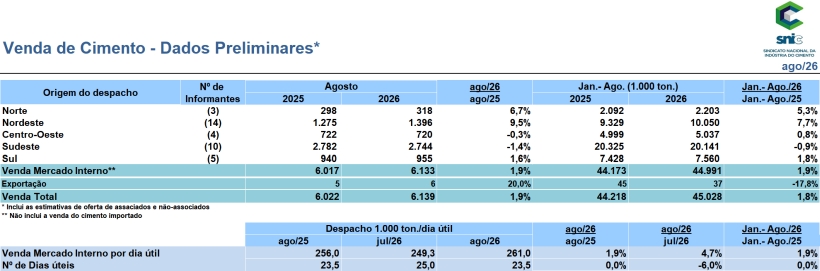
Preliminary Results for August 2026
August 2026
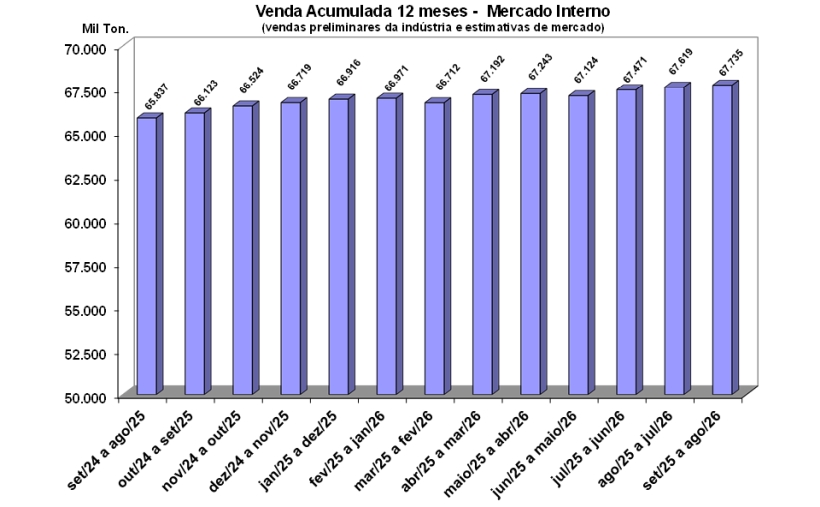
The Brazilian cement industry sold 6.1 million tons in August 2026, a 1.9% increase compared to the same month the previous year, according to the National Cement Industry Union (SNIC). Year-to-date sales (January through August) reached 45 million tons, a 1.8% increase year-over-year. Shipments per working day totaled 261,000 tons, up 1.9% from August 2025 and 4.7% higher than in July of this year.
This result maintains the positive sales trajectory amidst a gradual slowdown in economic activity. A still-robust labor market and housing dynamics—particularly driven by the *Minha Casa, Minha Vida* program—remain key drivers of demand for the material. However, high interest rates, household debt and delinquency, and lower consumer and business confidence point to a more cautious outlook for the coming months.
The unemployment rate ended July at 5.3%, the lowest level for that month since the historical series began in 2012. The number of employed people hit a new record, reaching 103.3 million. The informality rate stood at 37.5%, close to levels seen in previous months. Worker income remained stable, showing early signs of a labor market slowdown.
In the real estate market, new project launches fell by 0.3% in the first half of 2026, while sales grew by 5.4%. The *Minha Casa, Minha Vida* program performed better: launches rose by 7.9% and sales increased by 15.5% compared to the same period in 2025. The program accounted for 58% of real estate launches in the second quarter—the highest share since the historical series began—and remains a primary source of cement consumption. Despite high interest rates, housing finance expanded. The number of units financed for construction through the Brazilian Savings and Loan System (SBPE) grew by 174% in the first half of the year compared to the same period in 2025. This trend reflects the new SBPE model, characterized by a gradual reduction in compulsory reserve requirements, greater use of capital markets as a funding source for real estate operations, higher property value caps, permission to hold multiple loans per individual taxpayer (CPF), and expanded credit availability.
Brazil's Gross Domestic Product (GDP) grew by 0.5% in the second quarter of 2026 compared to the first three months of the year—a figure below expectations. With this result, the economy posted a cumulative growth of 1.9% over the last four quarters, while the production of goods and services totaled R$ 3.4 trillion during the period. The slowdown in quarterly growth warrants attention—particularly regarding the performance of the construction, infrastructure, and industrial sectors, as well as investment trends—since these areas are directly linked to the demand for cement.
This scenario of more moderate growth also affects the expectations of consumers, the construction sector, and the industry. Confidence indicators point to increased caution for the second half of the year. Consumer confidence fell for the fourth consecutive month in August, with a uniform decline across all income brackets. Intentions to purchase durable goods and assessments of household financial situations showed significant drops, signaling a reduced willingness to consume.
In the civil construction sector, confidence also retreated, though performance varied across segments. Residential building, special engineering structures (such as bridges and viaducts), and installation works saw an improved business environment. Conversely, non-residential building, roadworks, and finishing services showed a deterioration in expectations.
From the perspective of the cement industry, there has been notable progress in the implementation of concrete pavement solutions for highways and urban roads—an initiative currently underway in over 200 municipalities across the country. Industrial confidence recorded its sharpest drop since August of last year. This result reflects instability linked to new U.S. import tariffs, cooling demand, inventory accumulation, and uncertainties surrounding the economic slowdown, fiscal issues, and the start of the election cycle.
Inflation estimates remain high. Market projections indicate that inflation will end the year above target once again. The forecast for the Selic rate at the end of 2026 rose from 12% at the start of the year to 13.75%, reflecting external and internal uncertainties, concerns regarding the trajectory of oil prices and their impact on costs, and the worsening fiscal imbalance.
Household consumption capacity remains constrained by debt and delinquency, a situation exacerbated by the rapid rise of online betting. Despite pressures on family budgets, the cement sector remains optimistic about sales seasonality. Historically, the product performs better in terms of sales during the second half of the year, a period that may foster continued demand linked to the labor market, affordable housing, and infrastructure investments.
"The cement industry is monitoring with concern the discussions regarding the proposed constitutional amendment (PEC) to end the 6x1 work schedule. The proposal is currently under review in the Federal Senate, and any resulting change in labor laws could significantly increase the industry's operating costs. At the same time, the sector plays a vital role in the country's development, prompting the formulation of a series of proposals for federal and state government candidates. These include solutions ready for immediate implementation in infrastructure, sustainability, and decarbonization, as well as initiatives regarding waste management and the use of recyclable materials. Such measures can help sustain the industry's performance in the coming years—an activity that is strategic for economic development and growth." — Paulo Camillo Penna, President of SNIC